Nerdcore Astrotypes: astrological archetypes revealed and explained through their correlations to comic books, cartoons, anime, video games, or anything else that falls within the realm of nerddom. This is where modern mythologies are serious business!

Sunday, March 18, 2012

A Game Of Thrones Tarot, Pt. 1

SPOILER ALERT: This article presupposes that you have read A Game Of Thrones/watched through the first season of A Game Of Thrones. I will make efforts not to spoil anything past that. (Though I will likely write a separate article that incorporates the entirety of the story thus far.)  

And now, a little mood music...


Words Are Wind - An Introduction That You Will Probably Skip

I’ve been meaning to write this article since around 2008 or 2009, whenever I finally caved to  my friends’ recommendations and dove into A Game of Thrones, the first novel in George R.R. Martin’s A Song of Ice & Fire saga. As you may have noticed, I have a bit of a compulsion when it comes to rooting out the underlying archetypal patterns in...well, just about anything that I really like. I find this to be a really useful set of tools in gaining a deeper understanding with regard to the characters and the world - just like in real life.

So, what’s prevented me from tackling this subject long ago? One factor is this: ideally, the Tarot should loosely represent a story. Stories have endings, and this story has a few novels to go before it reaches its conclusion (and the more pessimistic of our lot have speculated that this day will never come.) But basically, a character that I believed to be a crystal clear representation of “The Magician” at the beginning of the story might be better allocated to “The Tower” after two subsequent books of strife and hardship. The main deterrent, though,  has been the sheer SCOPE of it. The world is so vast, the characters so numerous, and of course, it only grows further as the series progresses. By the time we get to A Dance With Dragons, there’s enough material to make five different Tarot decks.

All of this considered, I decided that the best way to proceed would be to confine this article to Season One, the real A Game Of Thrones. This works on a few levels - one, while a character’s allocation might change from book to book, this is fitting, as many of us transition between roles in our every day lives. So while you might feel like someone you know is “The Hermit” in your life, they may completely come out of their shell a year later and become “The Sun.”. It’s a matter of perspective. Works the same way in fiction, or at least in as sprawling a tale as this. There’s also the matter of deaths and replacements...we all know Martin has no qualms killing off a major character, and it may come to be that, looking at the story a few books down the line, an archetype left uninhabited by the death of a major character may find a perfect replacement later on. I will address this a bit further as I go through each on the major arcana in more detail.

GoT + Tarot = Metal.

A Game Of Trumps
A quick word about Tarot...a lot of people believe that the origin of Tarot cards are draped in secrecy, and that they may have roots that trace back to the Ancient Egyptians. But no one knows for sure, because they are SUPER mysterious!

Yeah...this is not actually the case. Tarot comes from a 15th Century Italian card game called Tarocchi. It’s still played regularly in some parts of Europe. The reason that people associate Tarot with Egypt is because Victorian English mystics had a serious fascination with all things Egyptian, and considered its culture to be the font of all mysticism, and went around retroactively assigning pre-existing traditions back to Egypt willy-nilly.

The deck is actually very similar to a normal Poker deck - there are four suits of cards, each numbering 2-10. Each has an Ace and a set of Face/Court Cards. (Slight difference here...whereas normal decks use King, Queen, Jack, the Tarot decks generally have some arrangement of four figures...most commonly known as Knight, Queen, King, and Page, the same archetypes are sometimes notated as Knight, Queen, Prince, and Princess.) 

The Viscoti-Sforza is one of the oldest surviving Tarot decks, dating back to the 15th century. The Tarot of Marseilles and the Rider-Waite (which was illustrated by Pamela Coleman-Smith, and thus should be known as the Colman-Waite deck, really,) set the standard for the appearance and format for Tarot decks to come.

Furthermore, the suits used today are analogous to what is used in the Tarot (Spades = Swords, Hearts = Cups, Clubs = Wands, and Diamonds = Pentacles or Coins.) This corresponds very easily to the traditional Western elements (Spades/Swords = Air, Hearts/Cups = Water, Clubs/Wands = Fire, Diamonds/Pentacles or Coins = Earth.) For more information on the traditional Hermetic elements, check out my Avatar: The Last Airbender article from a few years ago.

Long story short, you can read Tarot with a deck of playing cards. I have done so more than once after a night playing Asshole and Kings and Bullshit Pyramid. The major symbol set you’d be lacking are the Major Arcana, or Trump Cards. This is a fifth suit of cards, all bearing a title, which can defeat or “trump” any normal card. The only card in this this suit that is still included in a regular deck of playing cards is The Fool...except we call it “The Joker.” These Trump Cards come from a Neoplatonic Christian tradition called Triumph Parades, the point of which is that each one is considered closer to Godliness as they ascend. Traditionally, The Fool is the unnumbered Wild Card, because even the wisest of men has been made to look stupid by the ramblings of a fool, and not all “fools” are as stupid as they first appear. Since then, occultists have divided up these 22 cards into representations of the 4 elements, the 7 classical planets, and the 12 zodiacal signs. For more on Tarot history, refer to Robert M. Place’s text, The Tarot: History, Symbolism, & Divination.

One last thing on Tarot, specifically in the way that I came to these allocations: in some cases, there is a character who really just IS the card title...it is their actual title. An example: those familiar with A Clash Of Kings will know of the court jester known as Patchface, who should be “The Fool” for all intents and purposes. In cases like that, I will give them an honorable mention, or try to include them in some way. But overall, I feel the Trumps should highlight the most important characters in the tale. In some cases also, it seemed necessary to collect a few different characters serving the same function on one card. I’ll explain further as I go.

Anyway. On with it! For Winterfell!    

0 The Fool - Tyrion Lannister and Company - Prime Air


If anyone’s occupying the Wild Card slot, it’s our impish friend, Tyrion. The Fool card has been allocated to the element of “Air,” which deals with the intellect, freedom of thought, communication, and identity. The card classically portrays a motley character with his dog at his heels, representative of his instinct, trying to warn him of danger. It’s often read as a beginning to a new journey, the entrance into a new world - a fool knows nothing, and seeks to soak up all the knowledge and experience available. However, because of either their childish mind or appearance, the character is seldom taken seriously. However, as alluded to earlier, this is a powerful card that draws strength from being underestimated, and from the benefit of being generally unfettered by societal expectation and knowledge of the world.

As Tyrion is either regarded as a joke or a monster by most of his family, let alone by the rest of the world, he’s free of certain societal expectations. No one really cares that he goes to whorehouses, that he speaks and behaves in a vulgar fashion...he’s already viewed as an embarrassment and an outcast, so what’s the difference? You almost expect the guy to come home with a sellsword, a whore, and a few tribes of mountain raiders at his back.  

However, he is a Lannister - being of high birth and education, he’s well aware of civilized conventions, and feels free to invoke them or cast them aside at will. For example, he’ll think nothing of ridiculing a court with a heartfelt “confession” of past wrong-doings, but he knows enough about the law of Westeros to save his skin by demanding a trial by combat.

Admittedly, The Fool can often conjur an image of innocence and ignorance...Tyrion reveals this archetype more fully realized by trauma and experience. He recounts a tale of his youth to Bronn, his sellsword, and Shea, his prostitute consort, wherein we get a glimpse of that innocence. For those who don’t remember, this was the story of his romance with a country girl named Tysha, who he fell in love with and married in his youth, and who turned out to be a whore in his father’s employ who was paid to love Tyrion. He was made by his father to watch as a gang of men ravaged her and paid for her services, and then was made to do so himself. Lord Tywin Lannister did this to ensure that Tyrion kept to his station and did not think of doing “normal” things like getting married. The Fool often finds that it is an abomination of nature, and ends up shaking its fist at the sky, raging against its creator for being born. Tyrion’s relationship with his father brings this image to mind.


Tyrion may seem powerless at first glance, but he’ll surprise you - as the series progresses, he’ll continue to out-wit, out-fight, or otherwise maneuver himself around many of the other major characters in the series, and many no-win situations.  


I The Magician - Lord Petyr “Littlefinger” Baelish


The Magician is also know as “The Juggler.” Or, “Le Bateleur” or “Il Bagatto” in the French and Italian decks...these terms mean something akin to “Mountebank” or “Huckster,” and are meant to invoke the image of a sleight-of-hand artist. This is very different from the more recent occult representations of this figure, which are more noble and accomplished, portraying a man who has mastered the tools of ceremonial magic.

Littlefinger’s something in between these two ideas. He’s certainly a society type, and therefore conveys an air of nobility. However, his house is very low on the totem pole, a minor banner-man to House Tully, the lords of the Riverlands, and the wussiest of the major houses. Littlefinger himself grew up as a close friend of the Tully family’s two daughters, and found himself in love with the elder, Catelyn. However, since she’s way above his station, he had no hope of marrying her - she was eventually engaged to Brandon Stark, Ned’s older brother, who Littlefinger foolishly challenged to a duel and who dished out a savage ass-kicking in response. (Brandon, of course, perished at the hands of the Mad King, Aerys, and so Catelyn was instead married to Ned.)

Point is, Littlefinger realized then that he would never be a man of arms and brawn, but that his intellect could be just as sharp as any sword, and ten times as effective at gaining power. And so, like a trickster at a carnival, Littlefinger keeps getting people to step up and play the game, claiming their power, their resources, and their lives. He juggles plots and information, gauging each person by their role and their usefulness.

The Magician has been allocated to the planet Mercury, which is associated with the functions of communication and cognition. In mythology, Mercury (or Hermes) was the messenger god, fleet of foot, quick-witted, and always ready to cook up mischief. He was also the only one who was welcome anywhere - being a messenger meant that he could even go to Hades, a realm where none of the other Olympians were welcome. Due to his low-noble status, Littlefinger seems to enjoy a similar privilege, rubbing elbows with royals in one moment and managing a brothel in the next.

The Norse recognized the Mercurial current in the trickster god, Loki, who schemed and plotted until he brought the world down around him. As the series goes on, and the scope of Littlefinger’s influence becomes clearer, it causes one to wonder if he could be responsible for a similar set of events...

In the Rider-Waite deck, and as is pictured here, The Magician has full use of the four elements (vision, intuition, intellectual analysis, and a grounded sense of priorities,) and is pointing to the sky and the ground, fulfilling the maxim, "As Above, So Below," that prevails in ceremonial magic. This refers to to the concept that proposes that changes made to the symbolic world are reflected back onto the earth, changing the material world. And in a way, that's what Littlefinger does. Nearly all of his work is done by word and symbol, by deception and analysis, and he effects true and significant change in the world of Westeros by doing so.  

Varys, The Spider could also be a possible allocation for this position, though I like him better in another. More on him later...


II The High Priestess - Catelyn Stark
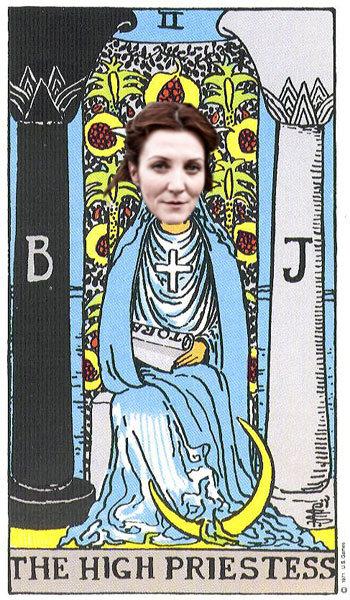

Well, I don’t know where the hell else to stick you, Catelyn.

Catelyn’s a character that really seems to divide fans. I don’t mind her so much, but a lot of people seem to absolutely loathe her. I think this is because a) people LOVE Jon Snow, who she can’t seem to stop riding for being another woman’s son, and b) she’s the ultimate over-bearing mommy, ready to do anything her children need, including run their lives for them.

In other decks, this card is called “The Papesse,” or female Pope. Either title reflects a high level of religious and spiritual understanding. Obviously, Cat isn’t that person. However, this card has been allocated to The Moon, the celestial body associated with emotional identity, family, nurturing, and with wisdom that cannot be understood without experience. In other words, you can read a how-to book about how to rear a child, but it’ll be very different and MUCH less information-dense than the actual experience of raising a child.

Catelyn exemplifies the willingness to sacrifice everything for the family, from fighting off a murderer who was trying to kill Bran, to venturing to King’s Landing to warn her husband of the plot against their house, to capturing Tyrion by raising the strength of her father’s bannermen (an extension of family, a base of power)...whatever complaints one may have about Catelyn, she’s certainly not a shrinking violet.

Kind of a bitch move at the end of the day, but still kind of badass. 

Regarding the “power of experience” factor, this doesn’t come into play in an overt way, but you do see signs of it now and then. For one thing, in the book, she’s the first one to realize that something is terribly wrong when Bronn is fighting Ser Vardis Egan in the duel for Tyrion’s life at the Eyrie. She’s done the circuit, seen a lot of tournaments, and knows what it looks like when someone’s losing a fight - while the rest of the court is laughing at Bronn’s tactic of “running away,” Catelyn recognizes that his movements are deliberate and calculated, and that he’s not worried in the least. This skill-set makes her a valuable adviser to her son Robb in future.

Lunar hurt leaves deep emotional scaring, and it usually takes a wound of that level to drive a person to revenge. Catelyn gives voice to these Lunar needs for retribution when she lays out their priorities to Robb. “First we get the girls back. Then, we kill them all.”

Meanwhile, Catelyn’s sister, Lysa, embodies all of the negative, horrible, Medea-esque qualities of The Moon. Without spoiling too much...you can already see that something’s terribly wrong when a lady’s still breastfeeding her eight year old son...but basically, the dark flip-side of the Moon is a pasture that’s willing to consume its own crops in order to strengthen the soil. Lysa prioritizes her own happiness over any member of her family, and the bond they share means very little at the end of the day.

There is one character - less prominent, but equally pivotal - who might be more fitting in this allocation. That is the witch, Mirri Maz Duur, who was actually a High Priestess for the Lhazareen people. The Moon has always been associated with witches and magic, and here, we have someone who had the emotional and familial core ripped away from her, and who plotted revenge because of it. Khal Drogo destroyed her country, her people, her family, even her god, and she responded by doing whatever was necessary to destroy the Khal and his unborn son. However, being that she is not one of our major players, I felt Catelyn to be a more appropriate choice. 

That's why you aren't supposed to suffer a witch to live.
There is another actual priestess introduced in Season Two, however, that would probably be an even better choice. Melisandre of Asshai is a sorceress and advisor of Stannis Baratheon, and will become a major player in the war for Westeros.

To conclude, the temple depicted in this Rider-Waite version of the High Priestess is the fabled Temple of Solomon. The Priestess herself is privy to all of the initiated mysteries. The black and white pillars in the background labeled "B" and "J" (yeah yeah, get the laugh outta yer system) stand for "Boaz" and "Jachim," the pillars of "Severity" and "Mercy," respectively. A fully realized version of this archetype, able to confidently perch between those two ideals, is really the most appropriate choice for this archetype, which is another reason Catelyn fits. 

III The Empress - Daenerys Targaryen


This was pretty easy. The Empress is the card of earthly pleasures, joys, of compassion and fertility. Its association is with Venus, planet of love and connections. It’s also typically code for “hot, young girl.” Dany is all of those things and more. Better yet, as Khaleesi, she is basically an Empress in title.

Dany’s journey iinitial journey is one of coming to know happiness. Her life up until the events of the first episode saw her dependent on her creepy, maladjusted brother, ferrying them from place to place and begging for their kingdom. The only things that really kept her going were small joys, memories she associated with a moment of peace and happiness here and there - a house by the sea, the feeling of a sea breeze. And so on.

She’s horribly depressed when she’s sold off to Khal Drogo, because he and his world are not things she associated with joyful experience in the least. They’re strange and different, and basically gross her out and frighten her. But gradually, she comes to find great happiness in her marriage and in her new lifestyle...so much so that she recognizes how joyless her previous existence was and treats her brother accordingly for putting her through it. Don't take my word for it...ask the lovely and talented Ms. Clarke...


Compassion is also a big part of the Empress card, and Dany is always the first and last one to fly that flag, no matter how much trouble it has gotten her into. Compassion, both for those weaker and less powerful, and for her enemies, is always factored into Dany’s plan for getting what she wants. We’ll see this more in Season Two, but her treatment of Mirri Maz Durr and her insistence that Khal Drogo stop the camp rapes is the first major indicator of this. She also gives a TON of chances for redemption to her brother, Viserys, only letting up when the situation had spiraled too far out of her control.

Daenerys, Venus, and The Empress all operate under the principle that life is not worth living, and stuff is not worth having (even kingdoms) unless you can enjoy it.

IV The Emperor - Khal Drogo
Pretty sure I'd get the tongue ripped out of my head for making this...
Another easy one. The Emperor’s consort is The Empress. Drogo’s consort is Daenerys. “Khal” is the closest title the Dothraki have to “Emperor.”

The Emperor is associated with the first sign of the zodiac, Aries. Aries is the most overtly martial and combative of the signs, is one of the natural positions of the war-planet, Mars, and is designated as “Cardinal Fire.” “Cardinal” refers to a sudden burst of force, “Fire” in this case meaning ambition, vision, and will. The typical Aries ideal is the action hero, the John McClanes of the world, who show their character in deed rather than in word. This can empower them with the drive to carve their name into the world in big, fiery letters. It can also make them pushy, combative, emotionally-unavailable dicks.

Khal Drogo was a Dothraki who just happened to be the best at killing people and leading armies. As such, he carved out a massive rep, amassed an unstoppable fighting force, and collected a shitload of bells in his braid. He was easily one of the most dynamic and beloved characters in the first book/season, and half the time we had no idea of what he was saying. You didn’t need to - once again, this is a man who ACTS. We see him drop his weapons and kill an armed man with his bare hands. We see him execute Viserys Targaryen in the most brutal and metal way possible (although that’s a bad example, as he had a pretty great line for that.) In the book, not as much in the series, we also see him be very tender and loving with Daenerys, which also speaks a great deal towards his character.


The Emperor is about surveying your weapons, your resources, your options, and then mobilizing them and leading them into battle. Very different from The Empress’ compassion, this archetype is about blazing trails and personal glory. Though it can be done for the accomplishment of some greater work, some higher purpose, it can just be the “I climbed the mountain because it was there” route. That certainly seems to be the case for the great Khal, a goddamn honey badger of a man who retired undefeated in personal combat.             

TO BE CONTINUED...

Sunday, January 22, 2012

The Gang Goes Retrograde

It's been quite a while, but I'm getting back into it. Posting now so my illustrious comeback begins before the Mars Retrograde.

(there's electional validity. it totally counts as an astrology-related post! okay, fine, it has to be nerdcore related? okay, okay...the imminent mars retrograde in virgo is like...umm...)

---

It's like The Gang on It's Always Sunny In Philadelphia. They have all this creative juice, but their application of it is always destructive, usually self-destructive, (negative tendencies of Mars,) usually involving substance abuse, and serve only to appropriately malign them further in the public eye (negative tendencies of Virgo.)


Much like a retrograde Mars, the tragedy is that their impulse to problem-solve and separate from unhealthy influence (Mars) is usually a very detailed and intricate scheme (Virgo,) indicating that the elements are present for a healthy planet-in-sign function. However, though incredibly detailed, the details of their plots and the values which inform them are usually so warped and demented (retrograde) that they cause the problem-solving energies to misfire and rebound back at the Gang destructively, or else destroy a completely undeserving target (like the very Virgoic "Ricketty Cricket" character, who carries the Virgo hallmarks of religious influence and crippling disability.)

In fact, all the members of the Gang carry some Virgoic qualities...all of their schemes aim for some low, Earth-based end (sex or money, usually.) Virgo is the sign of Mutable Earth, meaning that is seeks to take that which is Earthen (money, valuables, physical form,) and reshape it into something of greater value. Being ruled by the functions of Mercury, Virgo is the most detail-oriented sign, and have a particular sight for weaknesses in structural integrity. When Mars in applied to this filter, it will either seek to strengthen those cracks and make the structure more durable and valuable, or it will seek to exploit those weaknesses in structure and cause the whole of it to crumble. Being that Mars usually represents warriors, an example of a Virgoic fighter would be someone who exploits joint-locks (as in Chin-Na, Aikido, Brazilian Jiujutsu, and related styles,) or any fighter who strikes specific vital points.

Virgo professions tend to revolve around service to others, mostly because their eye for detail and improvement of structures can easily be applied to the medical field (doctors and dentists make people "more valuable" by making sure they function correctly,) any sort of craftsmanship or handy-man job, and even to servers and bartenders, who go and fetch something that will "fix you up," either by filling your belly with sustenance or by filling your liver with poison and making your day more bearable. Virgos tend to self-prescribe due to this line of thought, that ingestion of a particular substance is just the thing they need to function properly. Sometimes they're right, but often this also leads to addictive behavior and substance abuse.


Virgo is also associated with Hephaestus, who is the handyman of Olympus. Much like Hephaestus, Virgos usually know how to make or do a bunch of great, technically-complex things that everyone needs. They tend to be taken for granted in spite of this, and are unpopular with the rest of the pack because they're "that weirdo who spends all day in the shop, working on their nerdy inventions that we desperately need.") Also like Hephaestus, who was lame in one leg, Virgos often carry some disability. Whether it be physical, cognitive, or addiction-based/behavioral, there seems to be one little imperfection in their character that they cannot seem to smooth out, and they usually make the problem worse by obsessing over it.


Dennis and Mac are obsessed with physical appearance, fitness, and generally attractiveness in an unhealthy way - Dennis, to the point of personal malnourishment and sociopathic approaches to romantic manipulation, and Mac, to the point where he developed an eating addiction, gaining 50 lbs and a large pot-belly under the pretense that he has "gained mass." Charlie, meanwhile, is an ACTUAL handyman (though the only thing that falls within "Charlie Work" that he actually seems to be good at is rat-killing,) possesses a severe and crippling learning disability, and regularly takes partakes of inhalants.


These are unhealthy Virgoic tendencies. And given that they are all relatively young men, or were at the beginning of the show's inception, this makes them resonant with Mars. (...though if we were to really dice this out, I'd probably assign Dennis "Day Man" to the Sun, Mac "Night Man" to the Moon, and Charlie "Wildcard, bitches!" to Mercury.)


Although Sweet Dee and Frank don't fall into the "young man" Mars mold, it's worth noting that the two of them are the ones who usually have to work harder to get in on whatever the scheme is...the current is Martial, and they want in, despite the fact that they're the Venus and Jupiter of the group, respectively. But they are both extremely Virgoic. Dee rivals Dennis in overall shallowness, once shared an addiction to crack-cocaine with him, and used to be known as "The Aluminum Monster"due to the embarrassing back-brace she had to wear to correct her spinal alignment during high school. Frank, meanwhile, is an ex-businessman who is obsessed with prostitutes.

It is also worth noting that all of these characters now work in a seedy dive bar (low Earth) where they are servers. As stated, they have all had/have serious substance abuse issues in the past.

Perhaps most notable is the very specific title they carry, "The Gang." It seems good-natured enough, but also carries an implication of violence and thuggery. There was a familial current present somewhere at the beginning - Frank was introduced as Dennis & Dee's father, but it was revealed that he is not actually their blood relative, and they have treated him accordingly ever since...it was later revealed that Frank IS Charlie's biological father, but they are more buddies than anything. But this idea of family, and really even of friendships has been obliterated again and again throughout the course of the show's run. These are five people (five is the number of Mars in Qabbalistic thought, and it is the fifth classical planet of astrology,) who are drawn together by their similar destructive impulses. Their lives would probably be better if they all got the hell away from each other, but their perspectives are so warped that they have no idea how to sever themselves from unhealthy influence.

And that's a symptom of a malfunctioning Mars. Something to be aware of in the upcoming retrograde, which begins today. Laugh at The Gang, but don't be like The Gang!


Monday, March 2, 2009

Shaolin vs. Venus Retrograde

This edition of Nerdcore Astrotypes will be presented in Shaw Scope.


The Discordant Lover
---------------------
It's a continual source of wonder for me: how certain pieces of media float into my life at the exact time that current astrological conditions cause thematic elements within said media to truly stand out and be recognized. I've come to expect the movement of the heavens to dictate events here on the ground, but for whatever reason, I'm always blindsided by the fact that this should also apply to my television.

I will, occasionally, configure my Netflix queue to match up with upcoming transits for this reason. But the joy is really in the surprises, the times when randomly chosen entertainment offers insight into relevant archetypes.


Such is the case with Heroes of The East. I picked it up on the merit that it is a) an old school Kung Fu flick, b) produced by the Shaw Bros., and c) stars badass extraordinaire, Gordon Liu, well-known as the star of Shaolin Master Killer, and for his recent portrayal of Chinese folk anti-hero Pai Mei in Tarantino's Kill Bill. Little did I know, this spectacle of choreographed martial prowess would present lessons of a Venusian nature.


Gordon Liu, doing his thang.

Venus is the planet of social connections, desire and personal preference, and is generally code for all things pertaining to maidenhood and feminine youth. The planet is, of course, named for the Roman goddess of love and beauty, known to the Greeks as Aphrodite.

The plot of Heroes goes like this: Ah To (Liu) is a young Chinese man from a well-to-do family. His passion for Kung Fu has yielded considerable proficiency. He has reached marrying age, and his father has arranged a union to a family friend's daughter, a young Japanese woman named Kung Zi. Ah To abhors the thought of an arranged marriage, and vehemently protests until he sees Kung Zi's beauty first-hand. He is instantly won over by her bright look, her presence, and her charisma. Our Venus has appeared.

However, shortly after the wedding day, a few of Ah To's subordinates hear sounds of violence and a woman's pained groans coming from the other side of the courtyard wall. They comically assume that Ah To has taken to beating his wife. After being scolded for an imagined offense, Ah To goes to the courtyard to examine the source of the strange noises. There, he finds Kung Zi in full dogi and hakama (the pajama and skirt combo that can be found in various Japanese martial arts schools,) and finds her practicing the strikes, throws, and forms of Karate and Judo, two of Japan's most well-known martial arts. He comes to discover that she is as passionate about fighting science as he is, being well-versed in many different styles of weaponry and fighting tactics.

As with all martial ideologies, a dick-waving contest ensues between Chinese martial arts and Japanese martial arts. But who wants to get into a dick-waving contest with one's own wife?

This is the question which Venus presents in the fiery sign of Aries, where it has taken up residence since the first week of February, and where it will assume retrograde motion from March 6th until April 17th. Retrograde motion, for those who don't know, is a period when a certain planet appears to be moving backwards across the sky from our vantage point on Earth. The effect is that of turning the planet's energies on their head.

Rampage
-------
Those familiar with Mercury retrogrades will recall the misunderstandings, the miscommunication, the gridlocked traffic, the incomprehensibly slow internet connections, and the actual destruction of personal items that aided in relaying messages. I, myself, have had a couple of cell phones fall victim to this curse.

Even without the retrograde, Venus is already handicapped in Aries, universally considered to be one of its two Detriments, a place where its natural functions are subverted. Where Venus normally seeks to create connections to all that is sensually or intellectually enjoyable, the ram-like nature of Aries seeks only to dominate by force of will. Thus, Venus in Aries women are often slow to adopt the normal feminine trappings of make-up and fashion and soul-destroying gossip. This is the tomboy, more likely to watch Die Hard and slug softballs than to give half a shit about which pubescent pseudo-celebrity is gracing the cover of Tiger Beat.


It's kind of like this.

When (If) they finally do grow up and connect with the things that other women consider feminine, the tendency is to wield the subtle womanly wiles as though they were series of blunt clubs. This is the unfortunate lass who cakes on layers of bright eyeliner, who wears the lowest-cut dress with the brightest eye-sore plumage, who thinks that seduction equates to a tactless and aggressive deployal of tits and ass. Actually, that last one sounds pretty great. The true difficulties reveal themselves when the target of said affection expects the Venus in Aries woman to calm down and start acting demure or nurturing.

Cut back to our happy couple: while Ah To is delighted that his bride shares his interests, he questions the unladylike attire of the gi (which almost reveals her chest to the servants,) and the squatting, unladylike stances of her preferred martial arts. He attempts to teach her the graceful subtlety of Kung Fu footwork. This gets him slammed into the ground by Kung Zi's Judo throws. He laughs it off, confident that she will come around to his way of thinking.

She doesn't. She continues extolling the virtues of her nation's martial arts, claiming their vast superiority over Chinese martial arts. She also practices her breaking techniques on the courtyard walls, destroying them. She has all of Ah To's Chinese weaponry moved out of the training hall to make room for her own assortment of swords and spears, claiming that the straight blade and flexible spear that her husband employs are worthless to her. All in all, she unmans him in front of his family and Kung Fu brothers; he appears whipped and beaten by his woman. So, Ah To leaves soft reason behind and chooses a more direct and authoritative approach to the marital disagreement.


This, of course, leads to a sword fight. Then a spear fight. Then a duel with concealed weaponry. At one point, chopsticks are thrown with killing intent.

Kung Zi is beaten soundly. Ah To's Chinese weaponry and barehanded fighting techniques dominate her at every turn. He even mocks her sword work, claiming that the samurai bladework looks like “a beggar with a stick, trying to chase away a stray dog.” Unable to live in a home where her pride is forfeit, she leaves Ah To, running back home to Japan.

Distraught and desperate for his wife's return, a very drunk Ah To accepts the terrible advice of his comic relief second-banana: he issues a formal challenge to his wife, a duel in every category of weaponry and fighting style. Counting on her pride and tenacity, the hope is that she will accept the challenge, return to China, and be reasoned with. Instead, she shows the challenge to her many Sensei, all specialists of a particular Japanese martial discipline. They take it as an affront to their national honor.

And so, Kung Zi does return, but she does so with a posse of weapon masters, all ready to meet Ah To's challenge.


Are You Strong Enough To Be My Man?
-----------------------------------
The rest of the plot is expectantly mindless, pornography for action junkies. Ah To takes on each martial arts master in turn, one per day. He faces a Kendo sensei in a match with live blades. After a crash course in Drunken Boxing, he faces a Karate practitioner. There's a grappling match with a Judo guy, a stick fight, a knife fight, a spear duel, and finally, a showdown with a rival suitor who uses the stealthy and underhanded tactics on Ninjutsu. This being a Chinese film made by martial artists, it's basically an excuse for them to piss on Japan. Thus, Ah To wins every single contest (though he has to cheat a bit against the Judo guy, greasing himself up so he cannot be thrown.)

There isn't much astrological merit to talk up in any of this. But there are two plot points in the second half of the film that I think lend particular insight into the Venus in Aries archetype. My hope is that these insights may be of use to a man who finds himself on the business end of her affection. Or to a woman who finds herself particularly influenced by this transit, helplessly watching herself becoming a “psycho hose beast,” unsure as to why she cannot stop throwing punches at those she would like to kiss.

But first, a bit of backtracking for the purpose of clarity:

In a nutshell, the Venus in Aries archetype is proud of its personal tastes and desires, viewing them as an extension of personal power and identity. I work with a Venus in Aries girl who claimed she made “the best quesadillas.” Taking a bite of one, I smiled and said, “Hey, this is really good.” Stonefaced, she replied, “No! They're THE BEST.”


Another fine example.

This Venus is openly hostile to any affront to their personal power, whether that affront is intentional or perceived. In our film, Kung Zi defines herself and her power in a pretty basic way: by her love of strength and fighting prowess. Now, having had her power dominated by a greater force, there are generally two actions that this Venus will take: she will either a) submit to the dominant force, perhaps seeking its tutelage so that its power can become her own, or b) whine about the injustice of the circumstances, and seek out something with which they can punish their enemy. The militant feminist movement is a fan of the latter course.

Venus' retrograde movement is relevant here: Kung Zi actually “moves backwards,” retreating from her new home and married life to reevaluate her power in her homeland. There, she finds a means with which to punish her enemy, her husband.

Now, here is where the first of the two aforementioned interesting plot points comes into play. Upon her return to China, Kung Zi meets with Ah To, who berates her for bringing death to his doorstep. Surprisingly, Kung Zi offers a sincere apology. She did not want the masters to come to Japan with her, did not want them to answer the challenge in her stead. And she certainly doesn't want to see Ah To dead. Admitting her mistake, she offers him her help and support, and stays by his side as he answers each challenge, offering him advice, encouragement, and support.

Ah ha! Don't be surprised when you observe or experience reflections of this in the coming month. Those who are particularly influenced by Venus' retrograde movement will throw a tantrum, pick up their favorite dolly, and rip out its little stuffing-filled guts. But when it assumes direct motion, or perhaps before, they will sit on the floor and weep because they can no longer play with their favorite toy. It falls upon those who love her to either keep her from wrecking her own property, or to help her sew up the belly of some stuffed animals and assure her that they are as good as new. Nevermind the stitching, it adds character!

The other plot point: Ah To's first duel is against the Kendo teacher, who uses a real katana. He counters with what Kung Fu practitioners often call the “King of Weapons,” the gentlemanly Jian, commonly known in the West as a “Tai Chi Sword.” His graceful fencing out-jukes the deft, forceful slashes of his samurai opponent. Finding an opportunity to win, he pulls his strike short, resting the flat edge of his blade on the Kendo teacher's throat rather than slicing it open.

The Kendo teacher sheathes his sword. He then takes the sheathes sword in one hand, thrusting it forth. He has admitted defeat, and is attempting to offer his sword to the victor as a sign that he has submitted.

But Ah To is unfamiliar with this Japanese custom. He stays on guard, wary of a trick. The samurai takes this as a refusal of his respect, and a stain on his honor. He throws down the sword, drops to his knees, pulls out a dagger, and tries to thrust it into his own belly. Before he can commit seppuku (a form of ritual suicide,) his blade is kicked away by one of his comrades.

After their reconciliation, Ah To questions his wife about the incident. She informs him of the Kendo teacher's intention to surrender, and the insult that Ah To had unwittingly committed. She says that, had he taken the blade, they would have become lifelong friends, and he would have earned the samurai's eternal respect. But with the refusal, he could either expect the samurai to take his life or swear revenge.

Ah ha! This samurai is acting as a surrogate for Kung Zi's personal power – he is an extension of the Venusian current that is bringing strife to this scenario. But here is where the heart of the problem is addressed. The core of the conflict is that Kung Zi feels that her taste and power has been disrespected. Through the samurai's actions, we see that Venus (now considered direct,) is not unwilling to recognize that Chinese martial arts (the other party's opinions, preferences, power) have merit and are worthy of respect.

Had she drawn this conclusion at the start of the film, the two martial artists could have cohabitated without issue, respecting eachother's martial preferences. Ah To questioned her unfamiliar methods and trappings, mostly in a curious, inquisitive way. She saw this as open disrespect, and the nasty business unfolded without relent. But now that she has come to her sense, he has to be willing to trust and accept her again. If he can't, then there can be no peace.

Sure enough, Ah To and the samurai share the final scene of the film. Having defeated each of the masters, Ah To stands before them, where the samurai tries to instigate a second duel. Through an interpreter, Ah To apologizes for his actions, explaining that he misunderstood, and would be honored to accept the katana. Emotion heavy on his face, the samurai once again offers his blade up, this time accepted, and a lifelong friendship is presumably forged as the credits roll.

While the absence of conflict is an impossibility in a relationship, this truth is exacerbated through Venus in Aries, whose womanly individuality must be respected if favorable relations are to be maintained. She is strong-willed and independent, no stranger to a fight, and always up for a little lovers' quarrel. The difference is that the retrograde will see her looking to take these spats to a blood-feud level, and that she will likely go looking to start them at any excuse.

If you're this Venus' mate, walking on eggshells around the problem won't help. It'll probably be taken as a sign of weakness and a cue to steamroll you on any point of contention. If she wants a fight, then you either have to remain whipped and submissive, or man up and fight back. But as you do, make sure that your efforts to assert yourself are as benign as possible to her self-image. Look closely for signs that she wants to make up, as this can and should lead to make up sex.

One last Gamer Pro Tip: if all this talk about submitting and dominating wasn't a large enough clue, this Venus is often into bondage or some other manifestation of power dynamics in the bedroom. An impromtu wrestling match can make for great foreplay. This author suggests “Kung Zi,” “Jian,” or “quesadilla” as being potentially excellent safewords.


Wednesday, June 11, 2008

Venus in Gemini

The Girl in the Eye of the Storm

On Sunday, May 25th, Venus left her cozy dignity in Taurus, and set off into the wild winds of Gemini.


Like the goddess of her namesake, Venus' area of interest is in finding and reveling in pleasurable sensations. The movement of Venus into a new sign will also denote a shift in the overall demeanor of comely young women worldwide.

In Taurus, finding ways to please Venus doesn't take a lot of imagination – delicious food, a nice massage, a kiss. Its approach to pleasure is basic, tactile. This makes it very easy for Venus to operate here, where she deals with what is comfortable, stable, and physically pleasant. The Venus in Taurus woman is one who is desirable in an obvious but substantial way, and one whose desires are sated by the same method. She is a lovely young woman who is laid-back and easy to talk to, and she wants a piece of cheesecake.

Where Taurus' concerns center around life's bare necessities (food, shelter, sexual gratification, routine,) Gemini, ruled by Mercury, is all about intellect, versatility, easy acumen, and the schism of personality which can result in a polarization of values and (sometimes) mental instability. When the light of Venus is shined through this particular filter, the result is an aggressively brainy young woman, a "thinking man's sex kitten," who is likely more interested in chess than in cheesecake.


There is a suprising/disturbing amount of pornography devoted to this one.

Here, some distinctions should be drawn. Libra, Gemini's Cardinal Air cousin, is the other dignity of Venus. Like Venus in Gemini, Venus in Libra seduces and is seduced by what she finds interesting and intellectually pleasurable. However, Libra's penchant for balance and openness to new experiences leaves it in a much easier position to flirt and charm. Venus in Libra is a coquette who seduces through BEING an interesting and pleasurable experience, a person who everyone wants to know and talk to. For Gemini, however, polarization is fundamental, and Venus here may naturally divide a camp of potential friends into those who love her and those who cannot stand her. She's a debater, not an appeaser. She's got too much internal strife to keep it out of her interactions with others. However, her mutable nature and curiosity for a vast array of social interactions can also make her a bit of a chameleon, someone who can drift between very different cliques with no large effort. Just as the messenger god, Mercury, can travel anywhere and be welcome, Venus in Gemini can make friends anywhere.


Sexy Stolen Sandals

Being that Gemini falls under Mercury's rulership, I tend to think of the myth of Mercury's seduction of Venus when considering the mindset of Venus in Gemini. The myth goes a little something like this:

"Mercurius [Hermes] stirred by Venus's [Aphrodite's] beauty, fell in love with her, and when she permitted no favours, became greatly downcast, as if in disgrace. Jove [Zeus] pitied him, and when Venus [Aphrodite] was bathing in the river Achelous he sent and eagle to take her sandal to Amythaonia of the Egyptians and give it to Mercurius [Hermes]. Venus [Aphrodite], in seeking for it, came to him who loved her, and so he, on attaining his desire, as a reward put the eagle in the sky [as the constellation Aquilla]." - Hyginus, Astronomica 2.16


Gemini is represented by the twins, one being the divine/light twin, and the other being the mortal/dark twin. The two are utterly opposite in terms of principles, method, and manner, which in inconvenient in that they are irreversibly bound together in whatever planet is taking up residence in Gemini. Therefore, a lot of what Venus in Gemini is drawn to deals with that which seems either opposite or combatant. It is interesting to note that in the above myth, Mercury couldn't get the time of day until he took on an adversarial nature, thus becoming that "other" that Venus was interested in and drawn toward. It is also interesting to note that he was unsuccessful until he separated Venus from something that belonged to her, perhaps another nod to a sense of internal division and Venus in Gemini's need to reconcile the difference through combination of opposites. (Incidentally, their child is the androgynous god Hermaphroditus, whose name is the basis for the word "hermaphrodite," a very real example of this union of opposite forces.)


Solve for (Se) x

This myth plays itself out (minus hermaphrodite children) in David Auburn's play Proof, winner of the 2001 Tony and Pulitzer Prize, which was later adapted into a film starring Gwyneth Paltrow, Jake Gyllenhaal and Anthony Hopkins.

The play centers around Catherine, the daughter of a great mathematical genius who has just passed away. Shortly before the funeral, Hal, one of her father's best students, comes to their home to survey some of her father's final notes in the slight hope that he had discovered something important in a rare moment of clarity. Her father, Robert, had made revolutionary discoveries in his field very young in life, though his last twenty years had been an on-and-off battle with mental illness. Catherine acted as her father's caretaker towards the end of his life, at the expense of her own education and ambition.

Catherine is put off by Hal's intrusion of her space during a time of grieving, and accuses him of attempting to steal her father's work. A forced search of his backpack proves otherwise. She is apologetic and embarrassed by the hasty accusation, but as Hal tries to exit, a single notebook falls from under his jacket. Catherine, obviously enraged, calls the police. Hal tells her that he only meant to take it so that he could make it a present to her, as it contains praise and complimentary statements about her from her father's own hand.

Catherine's sister, Claire, turns up for the funeral. Claire is married, living in New York, has a sensible job, and is a bit of a yuppie. She presents a "light twin" opposite to Catherine, who is a disheveled Chicago resident with no career plans, having invested so much of herself into caring for her father. Though it was once implied that Catherine had inherited her father's brilliant mind, Claire also seems to believe that she has inherited his mental instability, and makes efforts to try and take control of Catherine's life.

Catherine and Hal end up seeing more of each other during and after her father's funeral. His good-natured, nerdy charm ends up winning her over, and the two end up sleeping together.

The crux of the play comes on the morning after, when Hal finds an amazing new theory among her father's papers, a long-awaited proof of a famous conjecture about prime numbers. His excitement is short-lived, as Catherine informs him that it was not her father's proof at all, and that she had written it herself. The question of her mental health and her lack of formal education make her statement hard to swallow for both Hal and Claire, especially given that her handwriting bears an uncanny resemblance to her father's. Catherine, meanwhile, has no way to prove (get it, "Proof?") that the theory is her own work. The rest of the play revolves around this issue, and the rift that has been driven between Hal and Catherine, who is hurt and shaken by his lack of trust in her intellect and stability.

Just as Hermes stole a shoe for a good cause, Hal also charmed Catherine by attempting to separate her from something that she was closely guarding – her father and his work were something that she came to consider a part of her being.

We also have a repeated theme of the classic Gemini "light twin/dark twin" theme. Catherine, with no credentials, questionable sanity, and aggressive demeanor, represents the dark twin in each scenario. While Claire certainly represents one aspect of polarization, Hal himself is another polarizing element to Catherine. Being a student of her father, he takes aspects of being one of his children, especially given that they both learned higher mathematics at his knee. There is an undercurrent of resent on both ends – for Catherine, she would have liked to have studied from her father in a formal, academic setting. For Hal, he would have liked to have known is teacher better as a man and a father figure. This twin effect in romance sounds kind of gross at first, but it makes a lot of sense given Gemini's allocation to The Lovers card in the Tarot.


Through Catherine, we can see that Venus in Gemini takes pride in expressing the contents of its mind, and in being taken seriously about that matter. Though Hal is able to charm her by proving himself intelligent and trustworthy, he burns this bridge when he is unable to extend the same courtesy to her. He neither trusts in her sanity nor her ability, and that is not a pleasant feeling to Venus in Gemini.


Rival Suitors and Fast Women

Another staple of this Gemini-polarization theme, when applied to Venus, is that it can cause division in the lovers that Venus in Gemini seeks out.

This can mean a lot of things. It can lead to mutability of partners (they get around.) It can also mean diversity of partner – I have a good friend with Venus in Gemini natally, and every girl he ends up with is completely different; he doesn't have a type, and is curious about all types of women. The only real link between the women he finds himself with is that they are all rather intelligent.

Another thing that'll often happen, whether by design or by accident, is that Venus in Gemini will cause two or more suitors to fight over her. I've seen it unfold in real life, and it's pretty gross.

A fine example of this type of polarization occurs in Martin Scorsese's Oscar-winning film, The Departed. This adaption of the Hong Kong action-thriller Infernal Affairs is a dangerous game of rat-versus-rat. Leonardo DiCaprio plays a cop who goes undercover in the mob. Matt Damon plays a gangster who acts as a mole in the Boston Police Department. Over time, the two become aware that there is a leak in the system, and take action to try to flush one another out.

Vera Farmiga plays Dr. Madolyn Madden, a Boston PD psychiatrist. DiCaprio's character is her patient, and the two carry on sessions with an air of dangerous flirtation. Damon's character, meanwhile, is her fiancée. As the battle between the two unfolds, she finds herself torn between loyalty and duty, unable to do much but distribute information to more powerful men on behalf of each of her suitors.

Dr. Madden is an accredited, confident, conventionally beautiful young woman who finds herself in a tumultuous and potentially dangerous situation. As such, she represents a polarization within this article, as the next person we're going to talk about is Marla Singer.

Marla Singer is a character from Fight Club, a book by Chuck Palahniuk which was adapted into a film by Jim Uhls and director David Fincher. In the film, Marla is played by the lovely and charming Helena Bonham-Carter. The character herself, though quick-witted as any Gemini, is a dark and self-destructive figure who chain-smokes through life while doing a lot of things you're not supposed to do (early in the film, she steals laundry from a out of coin-operated dryer, walks across the street to a used clothing store, and sells it,) and saying a lot of things you're not supposed to say (post-coitus, she remarks, "I haven't been fucked like that since grade school."). She is what a person might call a "fast woman," which is funny given Gemini's penchant for speed and fast-thinking – the reason why many who have important natal stuff in Gemini take a liking to the accessible, mentally-stimulating addictions like caffeine and nicotine.

The sexy & venerable HBC as Marla

She is the earliest representation of the anarchistic theme which runs throughout the plot. The anarchy delivered later on in the film is of a broader, revolutionary nature. Marla's attitude represents a sort of personal anarchy; no one can tell her that she can't do something if she knows full well that she is able to do it. According the Oxford English dictionary, it is a ""Absence or non-recognition of authority and order in any given sphere." In this case, the terms "authority" and "order" extend to what is socially acceptable; when we are introduced to Marla, she is attending a number of support groups though she shares no affliction with any of the attendees. For example, she meets the protagonist while attending a support group for testicular cancer.

The unnamed narrator of Fight Club (Edward Norton in the film) doesn't have testicular cancer, either. Like Marla, he is a "tourist," attending these support group meetings though not suffering from any particular affliction. He merely goes there for the emotional release, and so that he might be allowed to cry with a group of other sad people. The one thing that he does suffer from is insomnia, and the group hugs and catharsis of tears help him to sleep at night. That is, until Marla shows up at all of the same support groups, and the parasitic nature of his actions are reflected back at him.

Now, Fight Club is kind of an archetyping lay-up – the best friend/worst enemy roles that the narrator and the character of Tyler Durden (played by Brad Pitt in the film) take toward each other while working toward a singular purpose; it's all overwhelmingly characteristic of Gemini's internal strife, especially given their disparate nature and appearance.


But Marla's intrusion into the support groups is also a textbook patten of Gemini interference. She is the same thing as the narrator, only she has no qualms about the possible immorality actions. She polarizes him and reflects his own dark nature. Her appearance is likely a catalyst for the events which unfold when the narrator's dark side begins to take over, and the titular fight club is assembled.

Being that Marla is in the center of the conflict between the narrator and Tyler Durden, she also shares the same function as our psychiatrist from The Departed. For Dr. Madden, however, the fact that her suitors are on opposite sides of a war is a bit incidental; they would be fighting with or without her. For the narrator and Tyler, Marla is at the heart of their conflict; she's the one who caused them to divide and fight one another. In the end, though they have both slept with her, their feelings toward her are also polarized. One is in love and seeks to protect her, and the other sees her as a threat that must be eliminated.


Talk Nerdy to Me

Venus is not particularly strong in Gemini. Neither is it particularly weak, but occasionally it does take a little work to get a Gemini-type girl to put the book down and own up to being Venus-y. Kind of like the hot girl from She's All That, where no one knows she's a hot girl until she takes off her glasses and puts on a dress. But for a guy who's into Venus in Gemini, the preference might be that the glasses stay on. I know I had a big crush on Lisa Loeb back in the day, and I have a bigger crush on Dorothy Parker nowadays. (Dorothy was actually a Leo with a career ruled by Jupiter in Gemini. But that's another story...)

Legal!

At current, we can see this type of Venus in Sol's spotlight, as she walks hand in hand with the Sun through the middle degrees of Gemini, in conjunction with retrograde Mercury. While Mercury retrogrades are fraught with communicative malfunction, they are also a time for reconsideration, reconciliation, and quiet reflection. As stated, Venus is not in its dignity in Gemini, but Mercury is, and Venus is be taking its cues off of that selfsame retrograde.

Now would be a be a time for society to open its eyes and take notice of all the hot little Hermione Grangers and Tina Feys of the world. At the same time, it is a time when those same ladies will stop giving favor to either the angel or the devil on their shoulders and start recognizing that both have important things to tell them. We may see some good girls getting their groove back and some bad girls turning better. I hope not too much better, though. The world needs Marla Singers.

Speaking of singers...


Delicious Lisa Loeb. Not pictured: music.